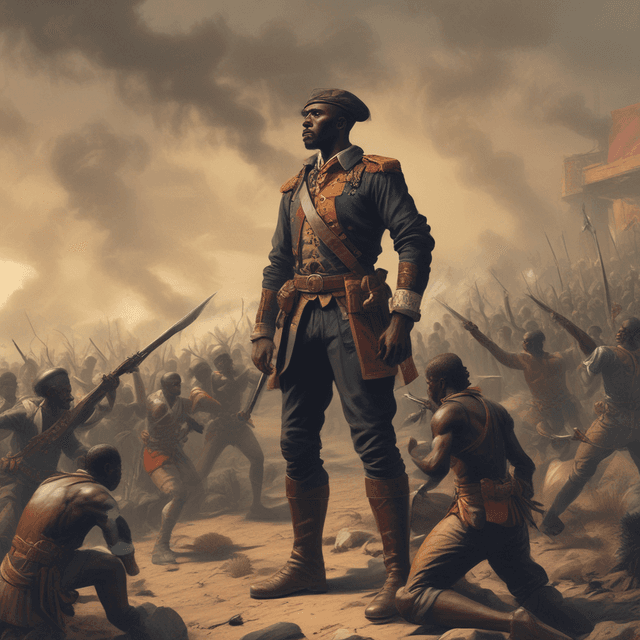
| Name | War on the Black Brotherhood |
| Cause | Brutalities of slavery and colonial rule |
| Outcome | Lasting impacts on the global struggle for racial justice and decolonization |
| Summary | A series of conflicts between European colonial powers and a network of secret societies, religious movements, and armed resistance groups led by people of African descent across the Americas and Africa, in response to the brutalities of slavery and colonial rule. The Black Brotherhood fought to overthrow European control and establish independent African nations, leading to crackdowns, military campaigns, and disinformation efforts by the colonial powers. |
| Objective | Overthrow European control • Establish independent African nations |
| Time period | Late 18th to early 19th centuries |
| Participants | European colonial powers • Secret societies, religious movements, and armed resistance groups led by people of African descent across the Americas and Africa |
The "War on the Black Brotherhood" was a long and complex series of conflicts that took place from the late 1700s to the mid-1800s, pitting European colonial empires against a loosely-connected web of secret societies, religious movements, and armed resistance groups led by people of African descent across the Americas, the Caribbean, and parts of Africa.
The origins of the Black Brotherhood can be traced to the brutalities of the transatlantic slave trade and the resistance it engendered among enslaved Africans and their descendants. Inspired by the successful Haitian Revolution, which overthrew French colonial rule in the 1790s, black revolutionaries across the colonies began to organize and plan their own uprisings.
These groups coalesced into what became known as the Black Brotherhood - a nebulous network of voodoo cults, Maroon communities, abolitionist societies, and armed guerrilla bands. United by a shared desire for liberation from European domination, the Brotherhood drew upon traditional African spiritual practices, Marxism, Pan-Africanism, and emerging black nationalist ideologies. Key early leaders included Toussaint Louverture, Denmark Vesey, and Gabriel Prosser.
Fearing the spread of the Brotherhood's revolutionary ideas, the major European colonial powers - France, Britain, Spain, the Netherlands, and Portugal - launched brutal crackdowns and military campaigns to try to destroy the movement. This included mass executions, torture, imprisonment, and forced exile of suspected Brotherhood members.
The most infamous incident was the Zong Massacre of 1781, where a British slave ship threw over 130 Africans overboard to drown, in order to claim insurance payments. This sparked widespread outrage and further galvanized the Brotherhood's resolve. In the following decades, the colonial powers also deployed extensive surveillance, infiltration, and disinformation tactics to sow distrust and division within the movement.
Despite the severe repression, the Black Brotherhood continued to wage a protracted campaign of guerrilla resistance across the colonies. Guerrilla leaders like Nat Turner, Queen Nanny, and José Leonardo Chirino led bold raids, prison breaks, and uprisings against the colonial authorities and their local enforcers.
These attacks were often suppressed with overwhelming military force, but the Brotherhood's nimble, decentralized structure made it extremely difficult to eliminate. The colonial powers found themselves bogged down in costly, unwinnable conflicts, even as the Brotherhood's ideas continued to spread.
The long struggle against the Black Brotherhood played a significant role in accelerating the decolonization of the Americas and parts of Africa in the 19th and 20th centuries. The Brotherhood's fierce resistance, along with the economic and political costs of the continuing conflicts, ultimately forced the colonial powers to grant independence to many of their territories.
The legacy of the Brotherhood also lived on in the emergence of radical black nationalism, pan-Africanism, and liberation theology movements across the Global South. Figures like Marcus Garvey, W.E.B. Du Bois, and Frantz Fanon drew direct inspiration from the Brotherhood's history of armed struggle against colonial oppression.
While the specifics of the "War on the Black Brotherhood" have faded from mainstream historical memory, its profound impact on global politics, racial justice, and the anti-colonial struggle continues to reverberate to this day. The sheer tenacity and vision of the Brotherhood, in the face of overwhelming force, remains an enduring symbol of black resistance against white supremacy worldwide.
